Canada's PM Carney Triumphs in Election as Opponents Concede

Mark Carney stated that Canada would “prevail in the trade dispute with the U.S.” following Monday’s electoral victory. As polls opened, U.S. President Donald Trump reiterated his suggestion to make Canada the 51st state of the United States.
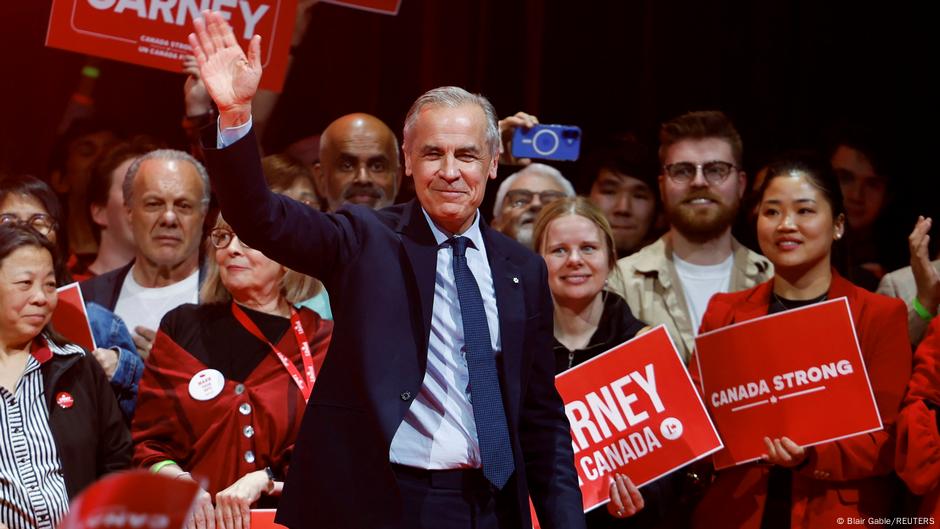
Prime Minister Mark Carney's The Liberal Party emerged victorious in Canada's federal election, as projected on Tuesday by the country’s broadcasters CTV and CBC News.
Pierre Poilievre, the opposition leader, admitted his loss as he was unable to break the Liberals' stronghold. However, he didn’t indicate plans to resign, noting instead that the Conservative party had managed to boost their seat count by over twenty.
It remained uncertain whether the Liberals could obtain the 172 out of 343 parliamentary seats required for an outright majority, as stated by CBC. At present, the Liberals held the lead in 161 constituencies, whereas the Conservatives led in 150.
CTV News forecasted that Carney wouldn’t secure the majority needed to improve negotiations for trade deals with Trump.
This signifies a return for the Liberals, after their previous decline in popularity. ex-Prime Minister Justin Trudeau resigned in January this year.
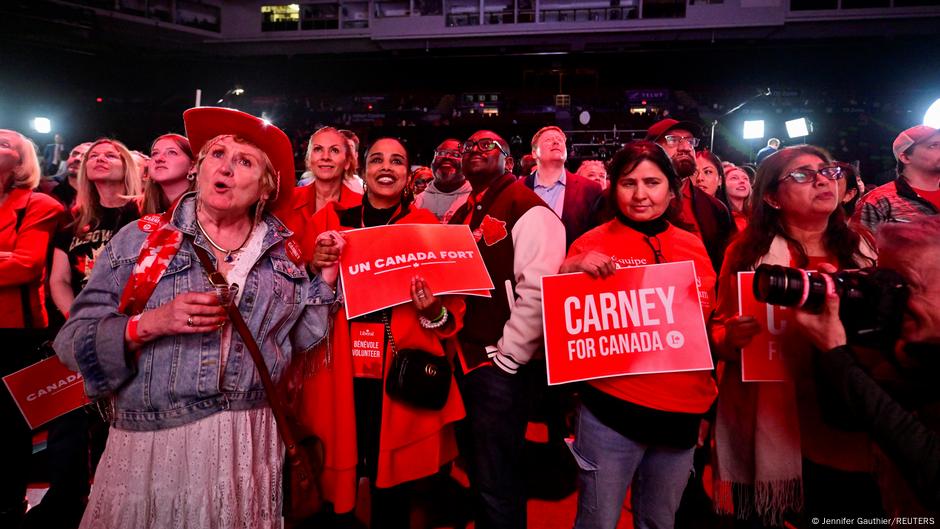
The Bloc Quebecois, a political party advocating for Quebec's separation from Canada, was predicted to secure the third position.
For four years as part of the governing alliance, the New Democratic Party (NDP) experienced a significant decline in backing, reducing their representation from 24 seats to an estimated eight. Following this outcome, their leader Jagmeet Singh announced his intention to resign once an interim head was appointed.
Singh acknowledged Carney’s triumph while expressing his own defeat in the parliamentary election. Many followers of the NDP moved their support to the Liberals due to concerns over US President Donald Trump's tariffs and remarks suggesting Canada could become part of the United States, which influenced voter decisions.
After his electoral victory, what remarks did Carney make?
After his win, Carney informed his followers that Canada will "emerge victorious in this trade conflict" with the US.
"We have moved past the shock of the American betrayal, but we must always remember these lessons," Carney cautioned, emphasizing that difficult times lay ahead.
“As I have been cautioning for several months now, America covets our land, our resources, our water, and ultimately our nation,” Carney stated. “These warnings should not be taken lightly; they pose real dangers. President Trump aims to dismantle us so that America can claim control over us.”
It will absolutely not...ever occur. Yet, we have to acknowledge the truth that our world has drastically transformed.
Why did Carney decide to hold a sudden election?
Carney was chosen by the Liberals to succeed Trudeau, however, he requested an election only nine days following his assumption of office to obtain a "clear, affirmative mandate," due to widespread dissatisfaction with his party’s performance.
He was competing against Conservative Pierre Poilievre, who led the polls prior to Trudeau stepping down. Nonetheless, several elements, notably including hostility from Canada’s influential southern neighbor, propelled Carney to an unprecedented surge in public support.
Approximately 29 million Canadians cast their votes. in the nation's sudden election The initial polling stations to open in the large G7 nation encompassing six different time zones started operating in the Atlantic region of Newfoundland and Labrador.
An all-time high of 7.3 million votes were recorded prior to election day.
The nation has been grappling with a cost-of-living crisis, and Trump's warnings about implementing tariffs appear poised to strike the nation's economy even harder.
Given that 75% of Canada's exports are directed towards the United States, both contenders mentioned their intention to expedite initiatives aimed at establishing a free trade agreement between the nation and its U.S. counterpart.
Trump's remarks grab the spotlight
Statements made by Trump regarding Canada potentially becoming the U.S.'s 51st state influenced the campaign. He brought up this idea again on Election Day.
"Imagine how stunning this territory would look. Unlimited access with NO BORDERS," Trump shared on his Truth Social page.
The Canadian Prime Minister, Carney, has consistently dismissed the notion.
"This is Canada—and we determine what occurs here," Carney tweeted on X.
Carney's rival Poilievre also adopted a comparable stance and urged the U.S. president to refrain from interfering in Canada's election.
"Canada will forever remain proud, sovereign, and independent," the Conservative leader wrote on X, adding that the nation will “NEVER become the 51st state.”
The " Trump effect" damages conservatives.
Many Canadians responded to Trump's approach towards the country by refusing to buy US goods and cancel vacations in their southern neighbor.
Carney’s Liberals, who initially seemed headed for defeat amid Trump’s warnings about undermining Canadian sovereignty and economics, went into election day at the top of recent poll standings. Meanwhile, Conservative Poilievre’s populist strategy, echoing some tactics used by the U.S. President, may have hindered his chances of winning.
Carney's victory at the ballots will also deal a setback to Trump, who has persistently criticized the Liberals, particularly during Trudeau’s leadership.
"The 'anybody-but-Conservative' sentiment, combined with the impact of Trump tariffs and Trudeau’s departure... allowed many center-left voters and habitual Liberal supporters to return to the party," said Shachi Kurl, president of the Angus Reid Institute polling organization, to Reuters News Agency.
Edited by: Richard Connor, Saim Dušan Inayatullah, and Alex Berry
Author: Tanika Godbole, Felix Tamsut (with dpa, AP, Reuters, AFP)